K2 — The Kinks
In a BLJB exclusive, Kinks drummer Mick Avory reveals that the soleful ‘kinky boots’ logo was inspired by an earlier version, designed by someone very close to home.

BLJB: So, straight to the point, who designed the very first version of the logo that appeared on The Kinks’ drum kit?
Mick Avory: It was my father [Charles Avory] who had a real eye for design. Of course, he did it just to help out. He didn’t get paid or get copyright on the logo, it was just something he did for me. It’s amazing that during all that time from when I joined the Kinks, nobody has ever asked me who designed the Kinks bass drum logo. So, this is a first as far as I know.
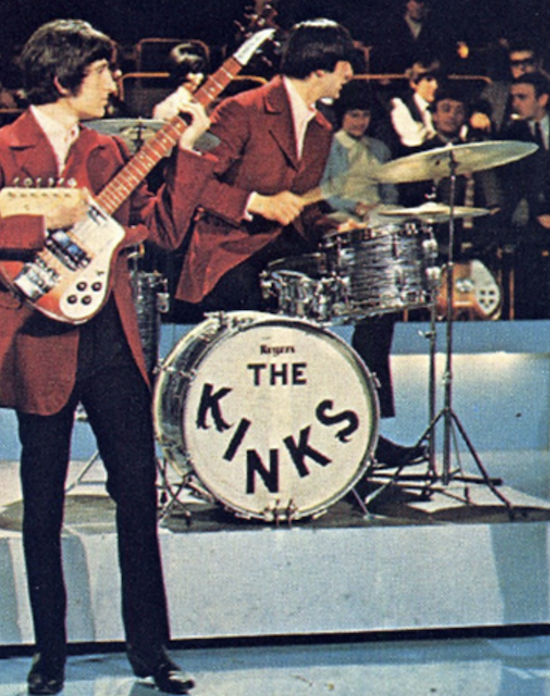
Drum roll … a rare sighting of the original Kinks bass drum logo, designed by Charles Avory. Note the ‘kinky boots’ on the K and the trailing finial of the S, which were co-opted on to subsequent logos. In the early days, The Kinks wore a uniform of red hunting-style jackets and cuban-heeled Chelsea boots.
BLJB: Can you tell us a bit about your father?
MA: Actually, my father was Italian, but his family came here when he was about four years old. He was born Carlo Avogadri, which later became Charles Avory. He lived in Titchfield Street in the West End during his formative years and went to St Martins School of Art. He studied fine art subjects. Painting, drawing, sculpture, modelling, wood carving.
BLJB: What did he do for a living?
MA: He first did sculpture and modelling work on commission, then he met a man who was setting up a fireplace business, and he designed all the fireplaces in brick, stone and slate and carved all the spangles on them. Then moulds were made, from which the fireplaces were assembled and finished.
But eventually, when the old man sold the business after many years, my father worked as a model-maker on successful films like ‘The Vikings’ and ‘Becket’ at Shepperton Studios.
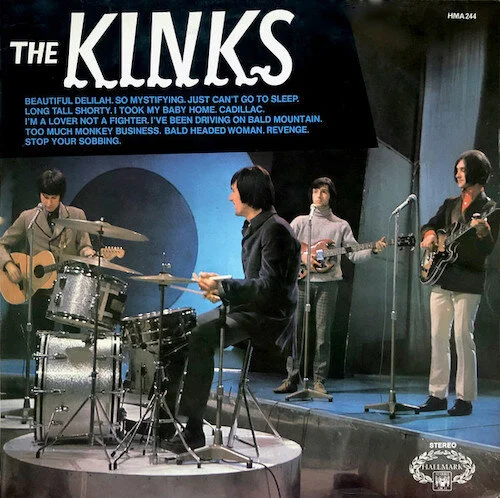
Walk the walk: Like The Beatles ‘drop T’ logo, The Kinks’ ‘kinky boots’ logo didn’t make it on to artwork for any of the band’s 24 studio albums. However, several versions appeared on compilations and reissues, like this 1973 Hallmark re-release of the band’s self-titled debut album.
BLJB: How did the logo design come about?
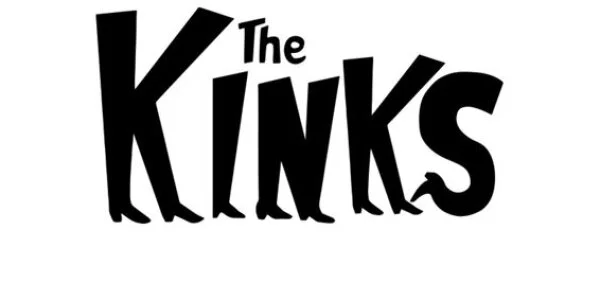
MA: When I joined the Kinks in January 1964, I mentioned to my father that I needed a logo for my bass drum. No more was said, he just came up with the idea using what he knew about the band. The emphasis is obviously on the kinky boots that we were issued to wear, plus the kinky lettering. Nothing else to it really. I honestly can’t remember who did the logos after that, probably a few different people, but they only resembled the original and weren’t exactly the same.
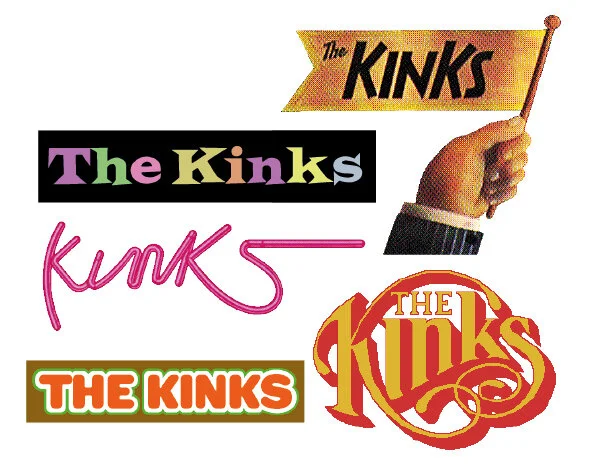
A medley of logos de jour as featured on various Kinks albums: (clockwise from top right) ‘Arthur (Or the Decline and Fall of the British Empire) design by Bob Lawrie, 1969; ‘Muswell Hillbillies’, design by The Bloomsbury Group, 1971; ‘The Kinks Are the Village Green Preservation Society’ design by Pye Record Studios, 1968; ‘The Great Lost Kinks Album‘, design by John Cabalka; 1973; ‘Come Dancing With The Kinks’ (compilation), design by Maude Gilman, 1984.
BLJB: What was the process for the design?
MA: I didn’t watch him do it, but I think he would have drawn it on paper first and then mapped it out on the skin to scale. Then finished it with black paint of some kind.
BLJB: What did the rest of the band think of it?
MA: The band didn’t tend to discuss that sort of thing. I just took it along and stuck it on the drum and that was it. I don’t remember them saying anything about it, I think Pete Quaife [The Kinks’ original bass player and a trained commercial artist] quite liked it, because he was good at that type of thing.
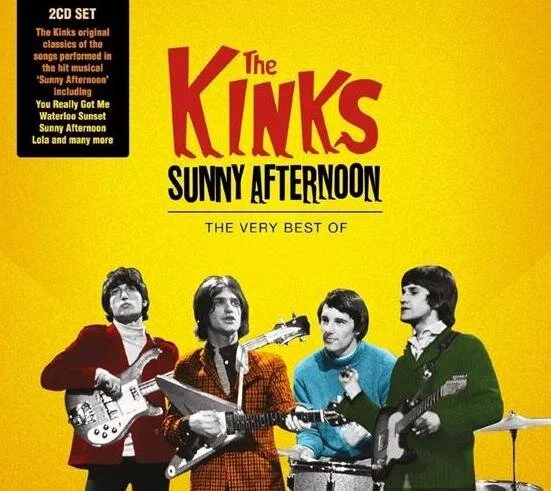
Walk on: The above logo sat on Mick Avory’s drum kit from 1965 to 1969. Possibly through longevity, this jaunty version became seen as the ‘classic’ Kinks logo, used widely on merchandise. Its designer is unknown, but was probably someone in the Pye Record Studios art department. Here it is on a 2015 ‘best of’ release celebrating Ray Davies’ West End musical ‘Sunny Afternoon’. Note the ‘kinky boots’ worn by the word ‘Afternoon’.
BLJB:How long did it stay on your drum kit?
MA: The original was done on my Ludwig Silver Sparkle Kit. When we went to the US in 1965, Ludwig invited me to go on a tour of the drum factory. They offered me a new kit, I hadn’t had mine very long, so I initially said ‘no’, but eventually they talked me into it.
But it turned out it wasn’t an additional free kit. They wanted mine in return, so I let it go. I could have kicked myself afterwards, for not realising it had extra value because of it being The Kinks’ drum kit. So they got the kit and the skin with the logo, the lot. How fucking naive was that! Never heard any more about it nor the skin.
I hated the kit they gave me. All the sizes were different and so was the sound. To top it all, our equipment was impounded by the customs when we got back to the UK. It was checked against the carnet form, and they found we had some different stuff on our return, so we got taken off and questioned about it. They wanted the band up in court, but in the end the roadie took the rap and the band paid his fine.
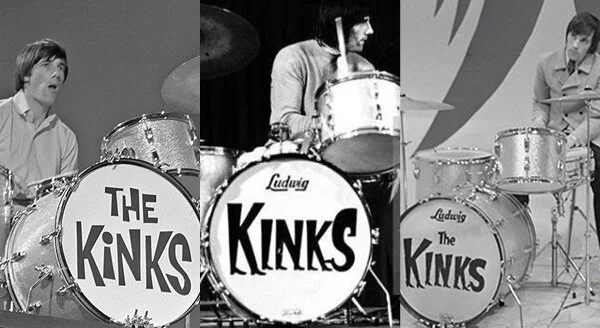
Drum logos agogo: The pic on the left shows Mick Avory on US TV show Shindig on 1 July 1965, with his new Ludwig drum kit and a temporary ‘non-booted’ logo.
BLJB: Why wasn’t your father’s logo used on any of The Kinks’ studio albums?
MA: I think the artwork for our albums was usually done by the record company unless the band had any strong ideas. As it was, the drum skin was back in Chicago. But I never used Ludwig drums again after that, not even to this day.
Huge thanks to Mick Avory for his time and this wonderful band logo story. And also to Bill Orton from the Official Kinks Fan Club for acting as go-between. We’re most grateful.
Further reading:
Official Kinks Fan Club website
‘God Save the Kinks: A Biography’ by Rob Jovanovic
©BandLogoJukeBox 2021. All rights reserved. No part of this post may be reproduced without permission.